What’s Up with Saturn’s Amazing Rings?
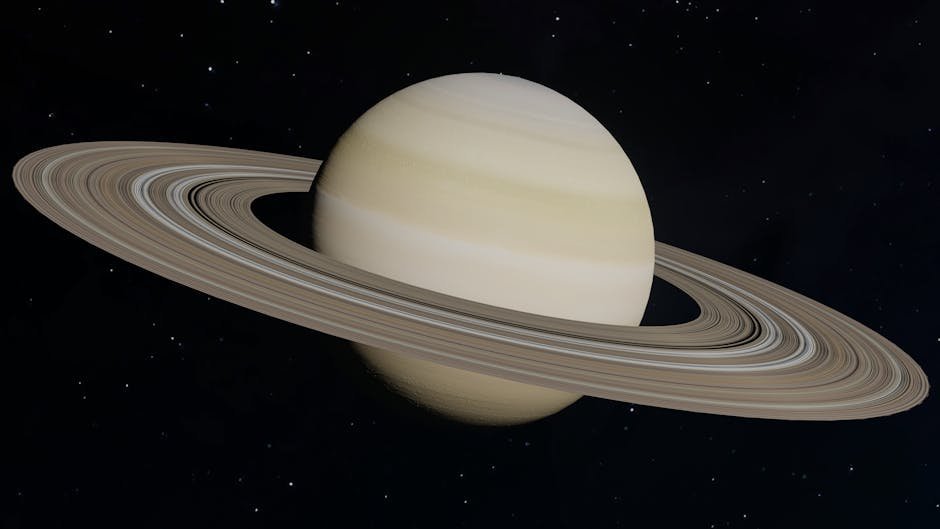
So, when you think about Saturn, what hits you first? Probably that incredible, gleaming halo: Saturn’s Rings. They look hella cool, don’t they? Seriously like some giant, glittering bracelet floating in space. Gives Saturn a totally unforgettable vibe. But get this: they’re not as special as you might think. Not even close.
Saturn’s Rings: Not the Only Game in Town
Yeah, everyone stares in awe at Saturn. Its gorgeous looks. But lots of folks don’t get that rings aren’t just for this one gas giant. Jupiter, Uranus, and Neptune – all the giant gas planets, you know? They’ve got their own ring systems. Saturn’s rings just happen to be the brightest. The flashiest. They simply steal the whole show.
For ages, smarty-pants like Galileo totally struggled to grasp these mysterious bands. He checked out Saturn, super puzzled, and just described it as three stars barely touching. And another thing: It wasn’t until Christiaan Huygens finally cracked the code, announcing his find kind of weirdly, that we finally got it. A thin, flat ring. Tilted, not stuck to the planet. Oh, and today we know that tilt is around 27 degrees compared to Earth’s trip around the sun. Wild, right?
What Are Saturn’s Rings Made Of? Just Ice
Early sky-watchers, like Cassini in 1675, squinting through their new telescopes back then, actually spotted the first big gap in the rings. The Cassini Division. That’s the one that splits the A and B rings. As new tech came along, more gaps popped up. Showing us a complex setup of at least seven different rings. D, C, B, A, F, G, and E.
For a long time, people thought these were like solid, unbroken discs. But physics, specifically this thing called the Roche limit? Said nope. An object too close to something huge would definitely get pulled apart by tidal forces. And James Clerk Maxwell, way back when, basically guessed it: the rings had to be made of countless tiny bits. Turns out, he was spot on. They’re mostly water ice. From tiny specks of dust to chunks several meters across. At their thickest, the rings are barely a kilometer deep. Super thin for something so massive.
Saturn: King of Moons
So, speaking of huge, Saturn is the total champ with moons in our solar system. The International Astronomical Union now says there are over 145 things circling it. That number shot up big time just this May, when astronomer Edward Ashton and his crew found 72 new ones!
These moons are a crazy mix. We’re talking icy spots possibly hiding secret oceans, and rocky, beat-up bodies straight out of some space movie. Some even act like “shepherds.” Yup, they use their gravity to carve out paths and keep the ring bits in line. Take Pan, a tiny 30-kilometer moon; it carves out a massive 325-kilometer wide gap. Literally guiding the ring material. Then there are the titans – no, really. Titan, bigger than Mercury, is the absolute largest one. Followed by Rhea. Then Tethys, Dione, Enceladus, Iapetus, and Mimas. Each with its own insane story.
The Big Ring Puzzle: How did they get there? When?
Okay, so where’d these amazing rings even come from? And how old are they? Scientists still argue about it, but we’ve got some good ideas. The most popular one suggests something about the size of Saturn’s moon Mimas got a little too close. Maybe it smashed up. And its broken pieces formed the rings eventually. Other theories suggest the rings are ancient, just like Saturn itself. Leftover stuff from when it first formed. Or maybe even bits of a comet that flew by.
But here’s where it gets wild: findings from the Cassini mission have totally messed with the “ancient rings” idea. Evidence now really makes it look like the rings are surprisingly young. What’s more, they’re disappearing! Super slowly. Sneakily, ice particles are raining down from the rings onto Saturn’s surface. In the faraway future, Saturn might just lose its famous ring. Gone.
Cassini’s Story and its Grand Goodbye
The Cassini-Huygens mission was a huge deal for space stuff. Huygens made history by landing on Titan. And Cassini? It orbited Saturn for years, sending back tons of new info and pictures we’d never seen before. It showed us so much detail about Saturn and its diverse moons.
The mission’s end? Epic, honestly. Cassini pulled off its “Grand Finale,” a bunch of dives through the rings and into Saturn’s atmosphere before breaking apart. In those final moments, it actually saw that steady shower of icy particles falling from the rings onto the planet’s surface. Real dramatic. What an end to an incredible journey.
Winds and Other Awesome Saturn Stuff
Way before Cassini, missions like Pioneer 11 in 1973 gave us our first close-up images. And Voyagers 1 & 2 offered early peeks. These missions, with Cassini, opened our eyes to the potential for liquid water on moons like Titan and Enceladus. Made us wonder if people could live there someday. Also, we learned about Saturn’s crazy atmosphere, home to the solar system’s second-fastest winds. Whipping around at over 1,800 kilometers per hour. Only Neptune beats it. And the planet has a super strong magnetic field too.
From Galileo’s blurry observations to the awesome, clear pictures from probes named after those pioneers, humanity’s trip to understand Saturn? Just mind-blowing. We went from just guessing from far away to sending our instruments right into its rings. Amazing.
Quick Questions About Saturn
Q: Are Saturn’s rings totally unique in our solar system?
A: Nope. While Saturn’s rings are the most famous, all gas giants in our solar system – Jupiter, Uranus, and Neptune – got rings too.
Q: What are Saturn’s rings mainly made of?
A: The rings are mostly just tons of tiny bits of water ice. From microscopic dust to big chunks several meters wide.
Q: How many moons does Saturn have?
A: Saturn is the champ for moons in our solar system, with over 145 recognized. That number got a huge jump lately with new finds.
Q: Did the Cassini mission find anything surprising about Saturn’s rings?
A: Yeah, big time. The Cassini mission showed us it looks like Saturn’s rings are pretty new. And another thing: they’re slowly fading away, with ice particles falling onto the planet’s surface.