Microsoft’s Majorana 1 Chip: A Quantum Computing Revolution?
Forget everything you thought you knew about quantum computing. Microsoft just dropped a bombshell. And it involves something called the Majorana 1 Chip. Not just another tech announcement. This claim? It could spark a whole new quantum era, potentially delivering stability we thought was decades away. Are we finally heading for a massive quantum revolution? Or just more tech bro hype?
Quantum Computing: Bits vs. Qubits and the Instability Problem
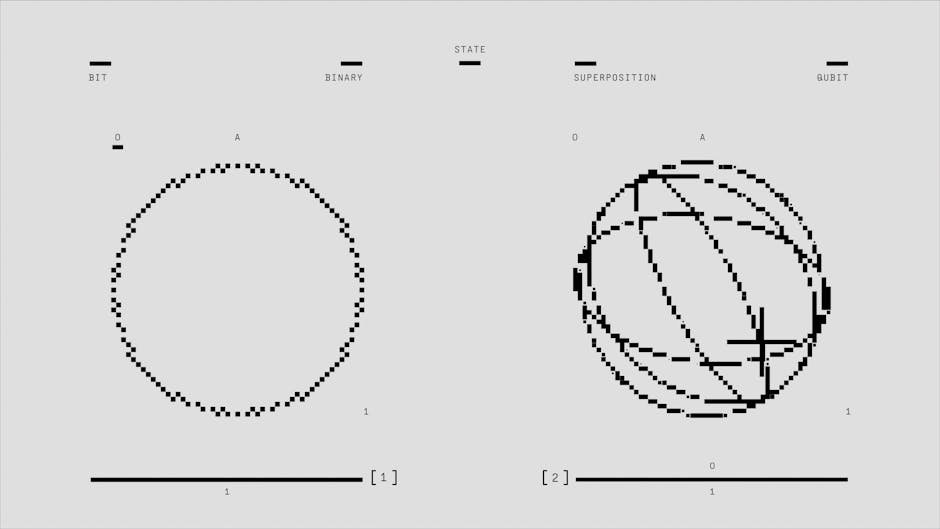
Classical computers run on bits. Simple stuff: a 0 or a 1. Qubits? They’re the quantum version, but way more powerful. They can be both 0 and 1. At the same time. Thanks to superposition, a real quirk. This superpower. The secret sauce for quantum computing’s big potential. Imagine Google’s 53-qubit Sycamore chip from 2019, supposedly crunching calculations in 200 seconds that would take old-school supercomputers billions of years. Also, IBM’s 2023 Condor processor, boasting over 1,000 qubits. Crazy numbers.
Sounds hella impressive on paper, right? But here’s the problem. Qubits? Super finicky. Like crystal vases – handle with care. Even a tiny shake, a phone signal, or a cosmic ray ruins a qubit’s state. Because of this, current quantum computers are massive, elaborate setups. They run near absolute zero temperatures. Seriously cold. And shielded by magnetic fields. Even then, stability is measured in microseconds. A hundred microseconds might as well be zero for real-world problems.
Then there’s the error game. Regular computers shrug off errors; they’re rare, like one in a trillion operations. Quantum machines? They misfire every 100 to 1,000 operations. So, to fix it? You need “logical qubits.” Made from physical ones. Lots of them. IBM’s roadmap says you need about a thousand physical qubits just to create one reliable logical qubit. Simulating a basic drug molecule? That’s 100 logical qubits. Meaning 100,000 physical ones. Building and controlling anything that complex has been practically impossible. Until now, maybe.
The Majorana 1 Chip: A Topological Twist
This is where the Majorana 1 Chip strolls in. Big claim. According to Microsoft quantum experts, like Chetan Nay, they’ve developed a “radically new approach.” Instead of software fixes for inherent fragility, they engineered a solution. Hardware level.
Microsoft says they made new matter. An entirely new state. A topological superconductor. Built atom by atom using indium arsenide and aluminum, this material supposedly allows the creation of Majorana particles. These aren’t just theoretical. Ettore Majorana, Italian physicist, predicted ’em way back in the 1930s. The magic, though? These particles inherently resist noise and decay. Biggest enemies of stable qubits.
This isn’t just a material. It’s a hybrid. It’s got semiconductor traits (power control) combined with superconductors (zero resistance current). This combo, say the folks at Microsoft, is a groundbreaking leap for quantum computing. Huge.
Paving the Way for Scalable Quantum Computers
Microsoft’s topological core? Major plus. Error resistance? Baked in. Hardware level. Old quantum computers fix errors with software, which means you need thousands of extra qubits just for error correction. Microsoft’s way? Hardware resilience.
Seen those quantum computers? Those big chandelier things? They look cool, yeah. But huge. Each qubit needs fancy cooling, hundreds of cables, and magnetic shields to keep it isolated and ultra-cold. Rooms full of gear. So much stuff. Not scalable. And another thing: trying to build a million-qubit machine with that architecture? You’d need a football field. Seriously. No exaggeration.
The Majorana 1 Chip wants to change things. Compact. Fits in your palm. Whole system drops into Azure data centers. The current chip has 8 topological qubits, but its H-shaped aluminum nanowire setup allows for tiling, scaling to millions. Each H-shape houses four controllable Majorana particles, forming one qubit. Disruptive innovation. That’s what we need! Think transistors, how they shrank classical computing from room-sized machines to something you can hold. This could totally change the quantum computing game.
The Million-Qubit Dream: Unlocking Complex Problems
So, why aim for a million qubits? Because that’s the ballpark figure scientists believe is necessary for “useful” quantum computers. Machines that promise exponential speed-ups. Tackle problems we can’t touch now. We’re talking about developing new materials. Carbon capture. Cancer treatments? Total revolution with drug sims. Groundbreaking AI? Powered by this.
Experts previously estimated we were 15 to 20 years away from stable, effective quantum systems of this magnitude. Some skeptics even grumbled it might never happen with existing tech. Why? More qubits? More problems. Seriously complex, higher errors. But the Majorana 1 Chip aims to shrink that scheduled time. From decades down to years. Fast. Microsoft’s target for hitting that million-qubit milestone? By 2030.
Hurdles and Hype: The Reality Check
Whoa, pump the brakes. Big announcement, sure. Not a done deal. Experts like Stephen Bartlett from the University of Sydney, excited guy, but he says the full topological qubit Microsoft wants? Not here. Not yet.
What Microsoft has done, and it’s in a Nature journal, is two big things: made Majorana particles, and figured out how to measure info from ’em. But here’s the kicker: no working topological qubit shown yet. Think of it like making a super new car engine. You’ve got a part for it, or a way to test it. Important stuff! But no actual engine. Not running.
This development is undeniably significant. Long road ahead, though, for a real quantum computer. This isn’t new this. Back in 2018, Dutch dudes said they found Majorana particles. Then they took it back. For now, Microsoft’s work? Peer-reviewed. No big complaints yet. But science needs other labs to check it. Add to it, too.
The Quantum Race: Microsoft’s Disruptive Innovation
Global quantum arms race. No doubt. This year has been declared the year of quantum technologies. News exploding. Microsoft’s way? Majorana 1 Chip. Focus on hardware error resistance. Could totally disrupt this wild competition. From Max Planck’s very early quantum theory seeds back in 1900, these efforts feel bigger now.
Some are super optimistic, thinking five years for the quantum age. But scientists need functional topological qubits. Scalable systems. Still crucial. The race is on. And the next few years are going to be wild.
Frequently Asked Questions
What makes qubits so unstable in current quantum computers?
Qubits are super sensitive. Everything messes with them. Tiny shakes, phone waves, cosmic rays? Pop! They lose their quantum state. Errors follow. So fragile. Gotta be in super controlled, ultra-cold spots.
What is a topological superconductor and how does it help?
It’s a fancy new material. Got bits of semiconductors and superconductors mixed in. Microsoft says they made one. It lets them create Majorana particles. Those resist noise and errors naturally. Big hardware-level stability for qubits.
Has Microsoft actually built a 1 million qubit quantum computer with the Majorana 1 Chip?
Nope, not yet. What they did do? Showed they could make Majorana particles. And how to measure quantum info from ’em. But a fully working topological qubit? That’s the core building block for a scalable quantum computer. Haven’t shown that yet. By 2030, they want a freaking million-qubit system. That’s the goal.