Sketching From Your Head: Tips & Drills for Artists
Ever scratch your head wondering how some artists just whip up pictures on paper, like magic? Well, it’s not voodoo. No, it’s a learned ability, known as drawing from memory. And let’s be honest, a lot of us totally get stuck trying to yank that perfect scene or body part from our brains and onto the page. But why is it such a pain? Because it needs real groundwork. Stuff like understanding proportion, light, shadow, perspective, and anatomy are, like, super important. If you haven’t put in the hours just looking at things, making those mental pictures happen feels impossible. But don’t you dare give up. Getting better at your drawing techniques? Totally doable.
Draw People and Stuff from Real Life (and Photos!)
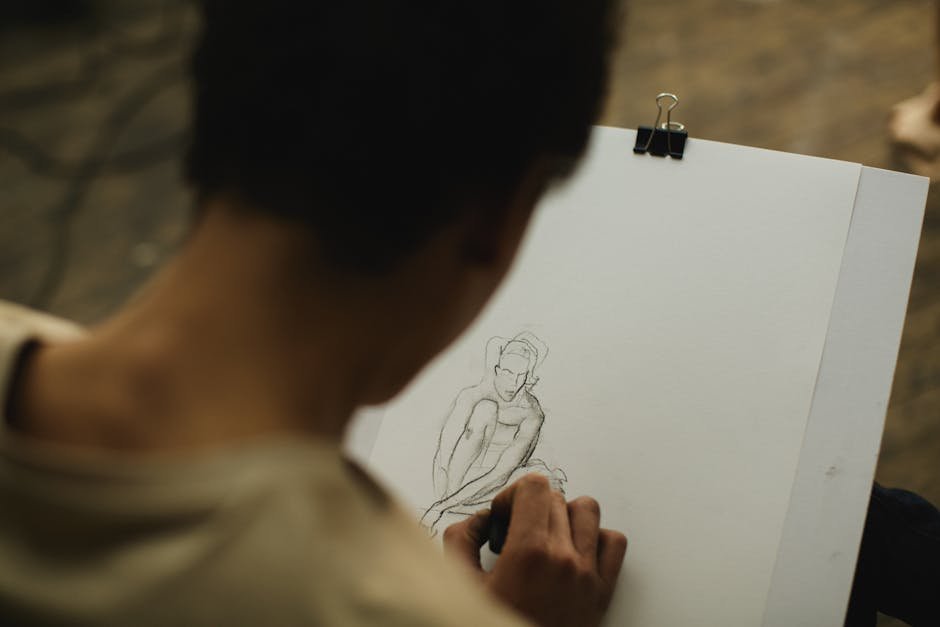
Before your brain can conjure things up, your eyes and hands need a workout. So, get ready for a ton of drawing practice from physical objects – sketching a friend, maybe. Or perhaps some gnarly old tree down the street. Reference photos work just fine if real-life subjects aren’t your jam. The goal? Nailing that hand-eye thing. It’s how your brain builds its own visual library for later use.
Supercharge Your Memory with Intense Looking
Ready for some hardcore memory drawing exercises? Grab a simple still life. A piece of fruit? A goofy candle holder from your own kitchen? Whatever. Then, just stare. Really stare. Give yourself like, 10 to 15 seconds, maybe even a whole minute, just checking out every curve, every shade. Afterward, ditch the object. Head to another room. Pick up your sketchpad. Now? Draw everything you can remember. You won’t get it all. That’s fine. Mission accomplished.
Go back to your setup. Look again. Focus on all the bits you missed last time. Then, back to your drawing space. Refine it. Keep doing this. You’ll literally be amazed how fast your memory — and your drawings — just click.
Let Loose with Blind Contour Drawing
This one? A seriously wild time. But artists love it in workshops, and for a good reason. Get paper and pencil. Shut your eyes tight. Now, just let your hand wander. Scribble. Doodle. Make whatever crazy marks you want across the page. Then, open up. Within that beautiful mess, start finding actual pictures. Is that a face? A strange character? Some weird landscape? No pressure here for perfection. But if something neat pops out, even better. Spin the paper around, too; new angles often show you fresh images. And another thing: this playful drill breaks you out of rigid expectations. It simply fuels pure, imaginative art.
Really Get How Objects Work, From All Over
To actually ‘see’ something in your head, you gotta know it inside and out. Pick an object. A spatula. A mug. Anything. Now, draw it from one view. Twist it a bit. Draw it again. Keep on rotating and sketching until you’ve grabbed it from a bunch of different spots. The whole point? To fully grasp its shape.
Once you can draw it right from a bunch of views, you’ll find you can close your eyes and still just “see” it. Also, same goes for faces: try imagining someone’s face from the side, then a little angled, then straight on. Or for scenes, redraw a landscape envisioning yourself looking at it from the left or right, not just the original spot. Yeah, it’s a game-changer.
Get Good at Perspective Drawing for Depth
Let’s just say it: skip perspective drawing? Your art will always feel off. It’s absolutely key. We’re talking one-point, two-point, and three-point perspective. One-point? That’s about a single spot where everything disappears, making things look far away. Two-point adds another spot, which makes for more complex spacing. Three-point, less common for everyday drawing, gives you that dramatic, looking-up-at-a-big-building kind of feel you see in skyscrapers and city views.
And remember this crucial tidbit: objects lose their vividness and crispness the further away they are. Stuff up close? Sharp and bright. Putting these small changes into your work instantly kicks up the realism when you’re drawing from memory.
Learn Proportion and Body Parts
Proportion is HUGE. Especially when you’re doing portraits or people. For faces, methods like the Loomis way can guide you to get those vital relationships down. But it’s not just faces. You gotta understand how bodies are put together — where muscles connect, how many “heads” tall a typical person is (and how that changes for dudes and ladies).
Work on sketching all sorts of body shapes. Practice your hands: look at every knuckle, the length of fingers, the structure of the palm. When you’ve really absorbed these basic size principles through regular practice, nothing at all will stop you from nailing them from memory.
Crack the Code of Light and Shadow
Light bounces around on things, creating bright spots, mid-tones, and deep dark areas. Getting this interaction right? Super critical. Grab an egg. Get a desk lamp. Adjust the light source. And watch the tonal fading – those subtle shifts from the brightest white to the darkest gray.
Experiment! Move that light from the left. Then the right. Then straight above. Look how the shadows move! See how shapes become clearer or hidden? Picture light like water from a lawn sprinkler: the wet spots are lit, the dry spots are shadowed. So if light hits from the right, the left side of a nose, for example, will be dry — shadowed — simply because the nose itself blocks the “spray.” Daily practice here builds your visual smarts. It shapes every mental picture you conjure.
When you’re trying to make imaginative or wild pieces, that first sketch on a tablet or computer can be your best pal. Don’t be shy about pulling in free-to-use objects for visual help with your compositions. Even pros like Jona Dry snap photos of themselves and their buddies, then tweak those pics to churn out their awesome, graphite surrealist art. Smart planning? Seriously levels up your drawing from memory skills.
FAQs
So, why is drawing from memory such a pain?
It’s just hard! Because it needs a rock-solid grasp of things like proportion, light, shadow, perspective, and anatomy. Without constant practice and really looking at stuff, it’s tough to make those mental images look right.
Do all the master artists only draw from memory?
Nah, not even close. Tons of old-school legends, like Vermeer, used tools like the camera obscura to draw what they saw. Today’s artists? They use models or mess with photo references. Sure, some styles (like Surrealism, Cubism) absolutely need stuff from your imagination, but usually, a strong skill at drawing what you see comes first.
How can I get better at seeing things for drawing?
Practice drawing from real life and reference photos often. Do those memory drills: stare hard at something, then draw it from another room, refining it after another close look. Also, pick one object and draw it from all angles until you can totally picture it in your head.